
Brands know more about their customers than they ever have. Most of it was gathered to sell something: to run a promotion, to place a wholesale order, to find a shopper online. That’s useful work. It just wasn’t built to answer the question a product team starts every season with, which is what to make.
So the data stays where it was collected. It lives with marketing, sales, merchandising and a sourcing team that answers to someone else. What to make gets decided by a small team in product development, and what reaches that team often shows up late, in pieces or not at all. The problem isn’t too little data, and it isn’t too much. It’s that the data and the decision don’t meet.
The research side shows a related split. Greenbook’s GRIT 2026 Insights Practice Report surveyed 735 insights professionals, 328 of them on the brand side. Among the brand-side researchers in the sample, 17 percent named early-stage product or service development as their single main focus. Plenty of the rest still spend time on early work. These are the people who spend their days with consumer data. My read is that the research gets done and then goes where it was aimed, which often isn’t the start of development.
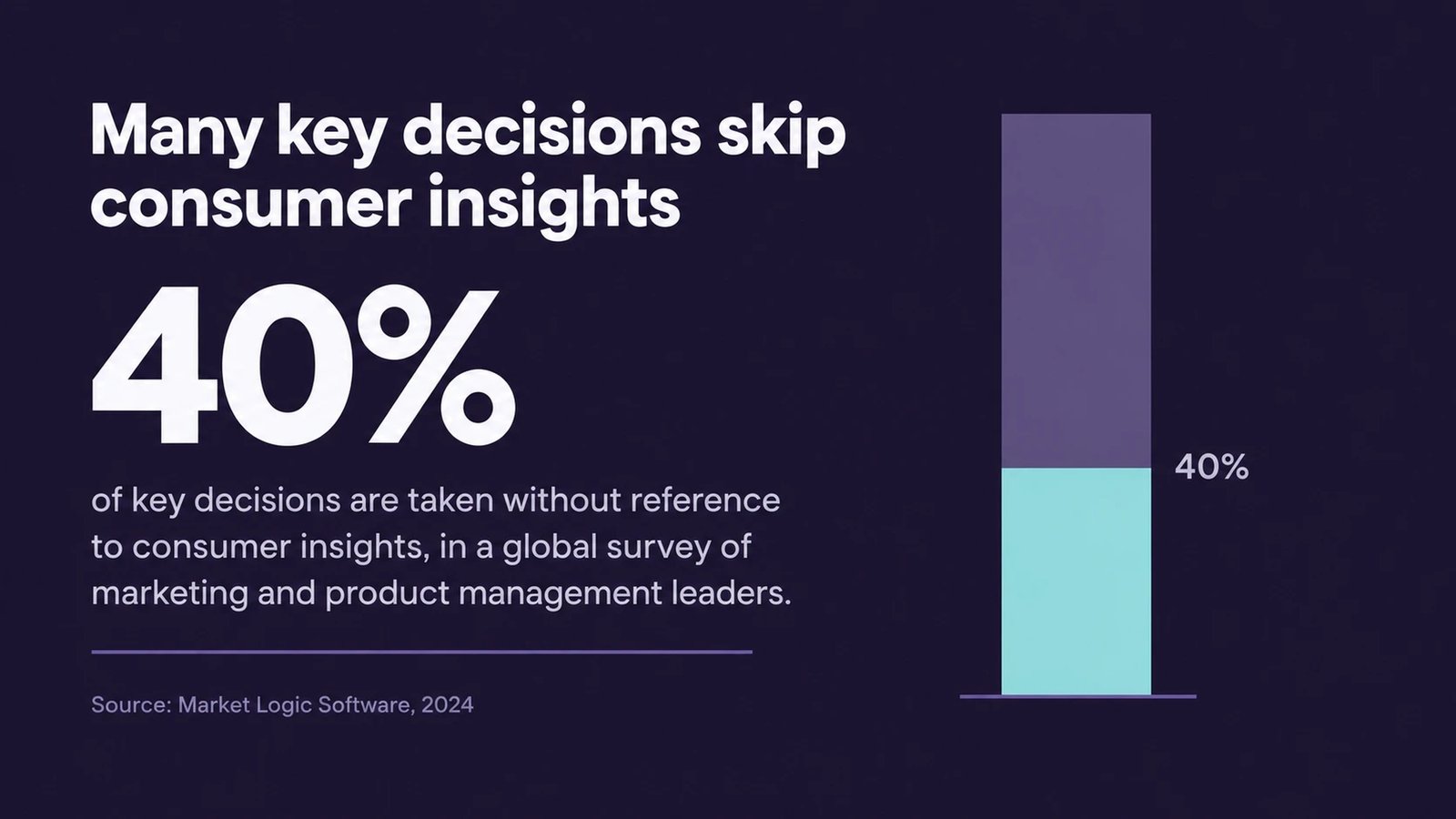
A survey from the decision side points the same way. Insight Platforms ran it globally among marketing and product management leaders, and the software company Market Logic Software published it in November 2024. It found that 40 percent of key decisions are taken without reference to consumer insights. That covers key decisions in general, not product decisions alone, and it comes from a vendor’s survey that’s a couple of years old. Still, the finding matches what the research side shows: the evidence exists, and a large share of decisions get made without it.
The decision point is the stretch before a product gets locked in. Once development starts, sampling, sourcing and costing all get built on what was decided, and changing direction gets expensive fast. Whatever the customer data could have told the team has to be in the room before that, not in a readout after.
Some brands have made that a priority. Carter’s, the children’s apparel company, names consumer-led product and innovation as the first of three strategic pillars in its long-term growth agenda, in an annual report filed in February 2026. The company says it’s investing to become a more consumer-led organization, with consumer insights informing product creation, innovation and assortment decisions across its portfolio.
Carter frames this as a change in how the company works, not a new research project. The aim is to turn consumer needs and preferences into clear product briefs. Putting that first among its priorities reads to me as a strategic shift: moving consumer insight to the decision point, before development starts, instead of letting it sit beside the process. The filing states the intent, not the result.
Senior leaders across consumer products see the same need. EY’s Consumer Products Dynamics Research, released May 27, 2025, surveyed C-suite leaders at consumer products companies with more than $1 billion in revenue, worldwide, between Feb. 21 and March 21, 2025. Of those leaders, 76 percent agreed that innovation is becoming more complex and increasingly requires analytics and AI. Fewer than a third, 31 percent, see themselves as highly effective at accelerating new product innovation.
Put side by side, the two numbers describe leaders who see the work changing faster than they rate their own ability to keep up with it. That’s not a gap more effort closes. My read is that most teams’ tools were built to track what happened, not to bring customer evidence to the call before it’s made. Analytics and AI can close that distance, and not only by saving hours, when they’re built for the decision point and used while the call is still open.
The first step doesn’t take a reorganization. List the consumer data your company already holds and where each piece lives, then find out who sees it and when. That map shows where the gap is. Closing it is harder. Getting the right pieces to the people making the call, every season, before a product is locked in, is more than a spreadsheet or a standing meeting can carry. Either way, put whoever knows the customer best in the kickoff room, not the post-mortem.
The data is already paid for. What’s left is getting it to the team before they start building.
Pull up the last product your team kicked off and check what customer data went into the decision. I’d like to hear what was missing.
With research from Greenbook and EY.